


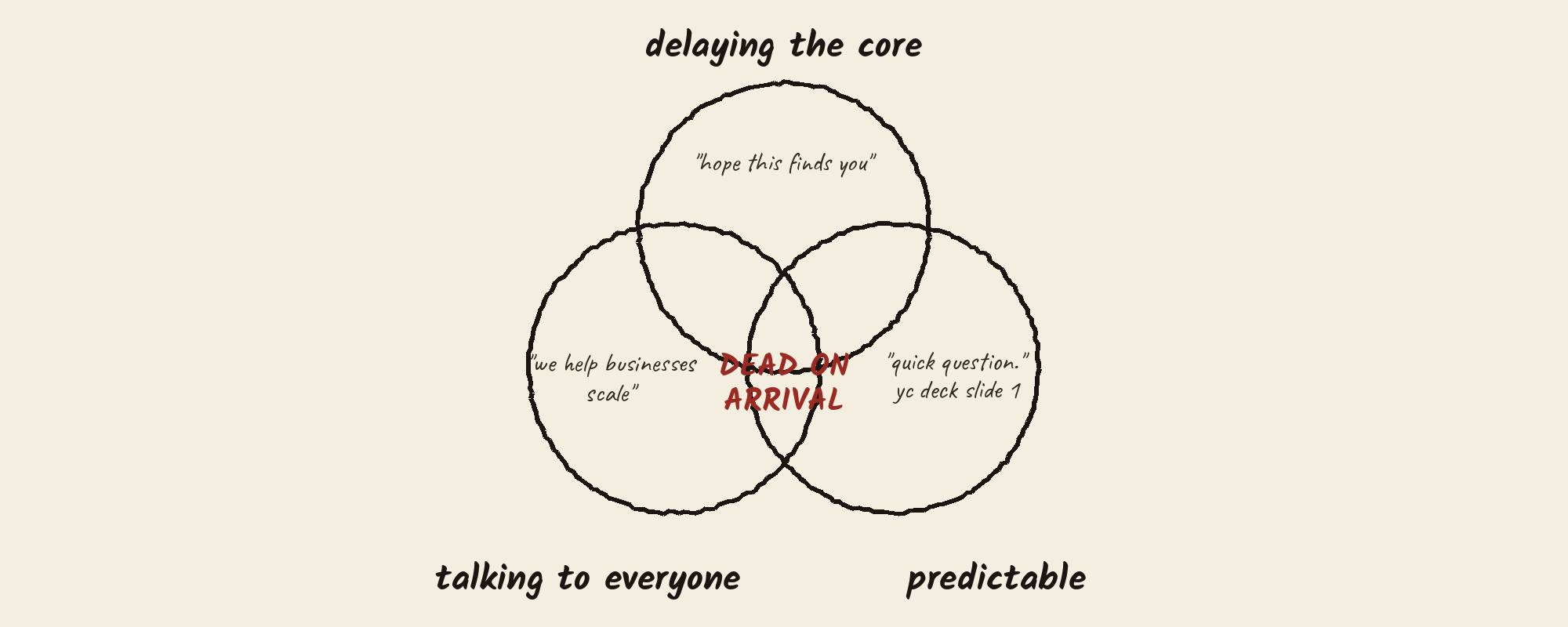
I’ve audited many b2b cold email sequences in the last year. they all fail in these places, only three places.
it doesn’t matter what the company sells. doesn’t matter if it’s a series-a startup or a 200-person scaleup. doesn’t matter if it’s a web3 protocol, a saas tool, or a fintech with a series-c. three failure modes. always the same three. most pieces of broken copy are doing all three at once.
and these three failures aren’t a b2b problem. they’re an attention problem. which is why the people who’ve actually solved them aren’t sitting in your sales org. they’re sitting in front of a phone, watching retention graphs, rewriting hooks until they pop. they have a name for each failure. they have a fix for each failure. the framework has been sitting in plain sight for five years, on a single slide that gets shown to every cohort of creators on day one.
it should be a slide in every gtm offsite. it isn’t.
1. failure one: you’re delaying the core

what it looks like:
cold email opening: “hi [name], hope this finds you well. i came across your company recently and was impressed by...”
landing page hero: “we help modern businesses unlock their full potential.”
pitch deck slide 1: a logo, a tagline, an “about us.”
demo opener: “before we dive in, let me give you some background on the company...”
each of these is doing the same thing: putting framing, context, niceties, or credentials before the point. the receiver who has roughly three seconds of patience, never reaches the point.
why it happens. politeness norms. sales training that emphasizes rapport before pitch. imposter syndrome dressed up as “establishing credibility.” the foundational mistake is the assumption that the receiver wants to be eased in.
the receiver does not want to be eased in. the receiver wants to know in three seconds whether to keep going. that’s the only decision their brain is making the moment they open your email or land on your page. delay the core, lose the receiver. forever, because they never come back to give you a second chance.
the fix. put the most disqualifying, most specific, most polarizing thing first. credibility is not built by being polite. credibility is built by saying something only an insider could say.
a cold email that opens with “you’re spending $14K a month on a crm you should have killed in q3” is rude. it is also opened, read, and replied to.
2. failure two: you’re talking to everyone

what it looks like:
subject line: “designed for modern teams”
landing page hero: “the platform for businesses of all sizes”
ad headline: “scale your operations”
pitch deck: “we’re building the future of work”
every one of these addresses an audience so vague that no specific person feels addressed. a hook that talks to everyone reaches no one. this is not a stylistic problem. this is a math problem.
why it happens. vc pressure to show a large tam. sales pressure to generate more leads, not more qualified ones. founders afraid to exclude potential customers. brand teams trying not to ruffle anyone in leadership review.
all of these are versions of the same fear: that being specific will mean being smaller. it will. that’s the point. a smaller, more qualified audience is worth more than a larger, more diluted one across every metric that matters — ctr, reply rate, conversion, retention, expansion. the founders who internalize this in year one outgrow the ones who internalize it in year four by an order of magnitude.
the fix. pick one icp. write the hook to them. let everyone else fail to relate. the creators teach this as the qualifying hook: “if you’re a college student who’s broke by the 10th of the month, watch this.” a hook that fails 90% of readers on purpose. the 10% who pass through are the only people you wanted anyway.
translate that to b2b: “for series-a founders still using zapier as your data layer.” eleven words, complete qualification. anyone whose stack matches reads on. everyone else scrolls.
3. failure three: you’re predictable

what it looks like:
subject lines: “quick question.” “[name] – 5 min?” “re: introduction.” “saw your post.”
landing page heroes: “scale your business” / “unlock your potential” / “transform your team” / “empower your operations”
pitch deck structure: problem. solution. market. team. ask. the same twelve slides y combinator published in 2014.
linkedin posts: “i’m thrilled to announce...”
each of these is doing what it’s supposed to do according to the same five blog posts everyone else read. the format itself signals this is sales / marketing / fundraising. the receiver’s brain has been trained to pattern-match and skip.
why it happens. best-practice anxiety. ai tools generating identical-shaped output across every team using them. brand guidelines enforcing “consistency” until consistency becomes invisibility. risk aversion: the marketer who copies what worked for someone else can’t be blamed when it fails. they can’t be praised when it succeeds either. but that’s not what they’re optimizing for.
the fix. read your copy out loud. if it sounds like every other piece of copy in your category, rewrite.
the opposite of predictable isn’t weird. the opposite of predictable is specific. specificity can’t be predictable, it’s only true of you.
a subject line that reads “your sdrs are wasting four hours a day on something an llm does in two minutes” is a pattern interrupt. a landing page hero that reads “the only b2b platform that doesn’t have a dashboard. on purpose.” is a pattern interrupt. a pitch deck that opens with one sentence like “we run go-to-market for $2bn of crypto aum with no marketing team” and a single number is a pattern interrupt. specificity is a pattern interrupt by definition.
the meta-point
look at the three failures together.
delaying the core = hiding the point.
talking to everyone = hiding from a specific person.
predictable = hiding inside conventions.
three flavors of the same problem: gtm copy that’s afraid to be specific.
every team that’s actually solved hooks and at this point, an entire generation of creators has solved hooks has solved them by getting over this fear. they put the point first. they address one person. they say something only they could say.
your gtm copy can do the same thing this afternoon. there is no tool you need to buy. no agency you need to hire. no quarter you need to wait for.
it is the cheapest fix in your entire funnel. it is also the one nobody is making.
if this piece described copy you wrote, the smallest fix is to rewrite one cold email subject line this week. tell me what you swapped in.