


However, Last Tuesday at 2 AM, I was lying in bed doing what I always do, scrolling Twitter. My thumb was moving but my brain had checked out twenty minutes ago and I was watching two people I don’t know argue about something I don’t care about, when I caught myself mid-scroll and thought: what am I actually doing right now? Not rhetorically. Genuinely.
What was I looking for at the bottom of this feed that I hadn’t found in six years of doing this exact thing every single night?
I closed the app. Moved it off my home screen. Opened Substack instead, mostly because it was the next icon and I wasn’t ready to put my phone down.
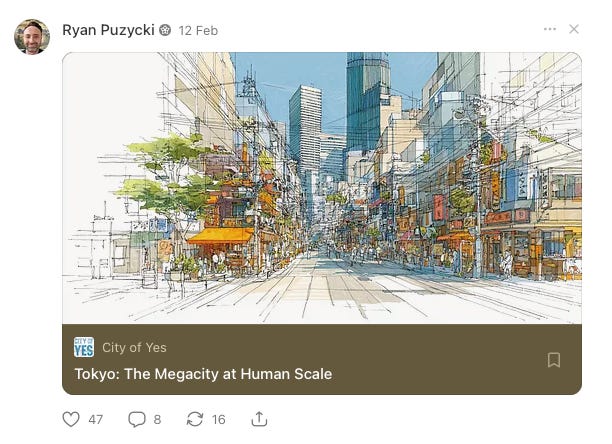
What happened next was small. I started reading an essay about urban planning in Tokyo. I have never been to Tokyo. I do not care about urban planning. But I read the whole thing. Ten minutes. Start to finish. And when I finished, I felt something I hadn’t felt from the internet in a long time. I felt smarter. Not stimulated or entertained, just slightly smarter than I was ten minutes earlier.
That’s a weird feeling to have at 2 AM. It’s not the feeling Twitter optimizes for. Twitter optimizes for the feeling of being in the know, which is different from actually knowing something. I had been confusing the two for years.
The next morning I went back through my Twitter analytics, mostly out of curiosity, because the night before had felt like a small jolt and I wanted to see if the data backed up the feeling.
Six years of posts. Tens of thousands of tweets. Hundreds of threads. Some of them had genuinely done well at the time a few had crossed 100k+ impressions, a few had ended up in newsletters I respected, one had gotten me a job offer. I scrolled to one of the articles I was proudest of, from three months ago. 90K views when it went viral. Today? Two clicks in the last thirty days. Six. I refreshed twice to make sure.
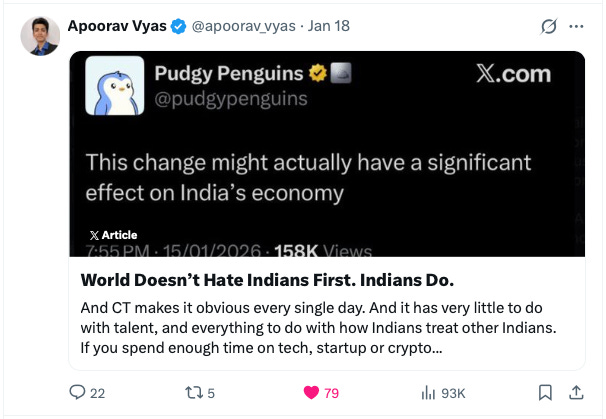
I clicked another one. Six months old. Same shape. Big spike, long flat death.
Then I opened Substack and pulled up the analytics on the best essay I’d written in the same window. Still getting reads every week. Still pulling in subscribers. I had been getting random DMs about it for two months, the most recent one that morning, from a founder I’d never heard of who’d found it through a friend’s WhatsApp.
That’s when something structural clicked. Twitter is a distribution event. Substack is a distribution asset. A tweet performs for four hours and dies. An essay performs for weeks and sometimes months. The half-life of a tweet is roughly 18 minutes. The half-life of an essay on Substack is, as far as I can tell, ongoing.
I had spent six years building things that disappeared.
I want to be careful here because I don’t want this to read as a “Twitter hit piece”. Twitter wasn’t bad for me. It was, for a long stretch, the most important platform in my professional life. I built distribution there. I met co-founders, investors and most of the people I now collaborate with daily. I developed my actual writing voice the one you’re reading right now, by writing 280 character thoughts every night for years. Twitter taught me how to think in public, and I’m genuinely grateful for that, and I’m never deleting my account not stopping to tweet.
But something flipped in the last eighteen months. The chaos that used to feel productive started feeling performative. The serendipity got replaced by an algorithm that decided what I should see based on what would make me angriest. And the writing, my writing started bending toward whatever shape the platform rewarded that week, which was rarely the shape that actually represented how I thought.
I didn’t leave Twitter because I found something better. I left because I stopped recognizing myself in the things I was posting.
The deeper realization, the one I came to in the days after that scroll, was about ownership. Or rather, the lack of it. For years, every follower I’d “earned” was actually borrowed. The algorithm decided whether the people who already followed me would see my work. The platform could change those rules any morning, and has, repeatedly, and the people I respect have all watched their reach drop 90% overnight at some point. We accept this as just the cost of doing business. I’m starting to think we shouldn’t.
Email is different. The address is yours. The list is exportable. If Substack disappears tomorrow, I can take everyone with me. That’s not a small feature difference, that’s a different kind of relationship entirely feels like what Web3 promises ngl.
So let me tell you about my actual numbers, because this is the part most people lie about and the lie matters.
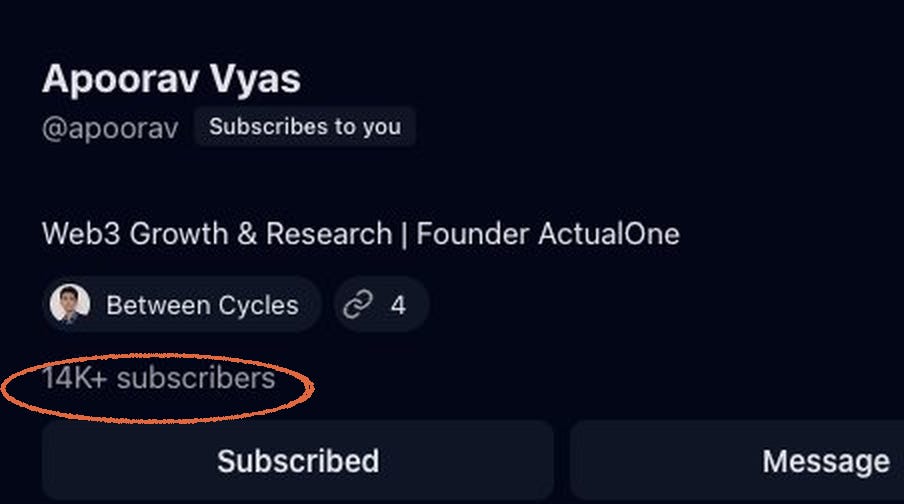
I have just over 14,000 subscribers on Substack. That sounds impressive. It is not, in the way you think.
The honest version: most of those subscribers came from email imports. Years of running events, building communities and operating @ActualOnexyz initiatives generated a large email list. When I moved seriously to Substack, I imported those lists. So if you’re reading this and thinking “wow, this person grew 14K organically on Substack,” please don’t, that’s not what happened, and pretending otherwise would be the exact kind of dishonesty I’m trying to avoid in this essay.
Here’s what did happen. Before importing a single email, I grew from zero to roughly 500 subscribers on Substack, organically, no tricks, no giveaways, no cross-promotions. Just publishing essays and letting people find them. 500 strangers who chose to subscribe because they read something I wrote and wanted more.
Then I imported the 14,000.
And the surprising part, the part that genuinely shifted how I think about this wasn’t the headline number. It was what happened to the open rates after the import. They held. Not just from the 500 organic subscribers, but from the imports too. People who had given me their email at a conference in 2023 were opening essays in 2026, reading them, sometimes replying and a average view rate was 5000/post
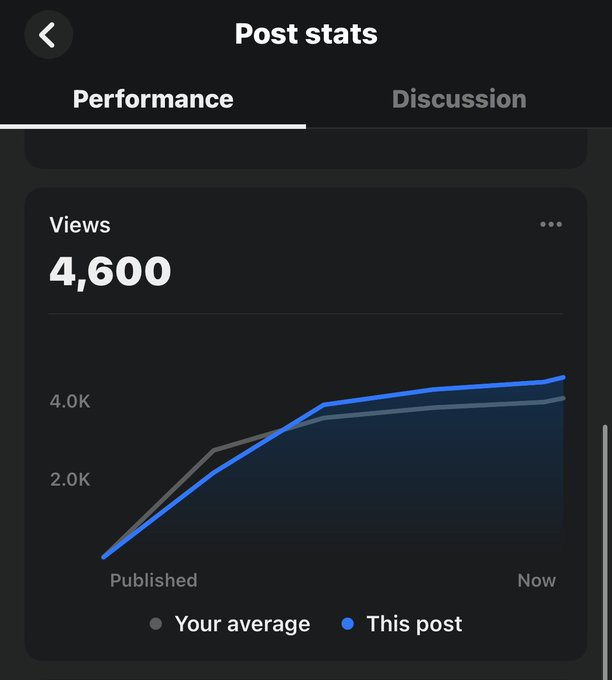
I had assumed imported subscribers would behave like dead weight, names on a list that boost vanity metrics but never actually engage. The data didn’t agree. The 500 organic subscribers told me one thing: the writing could attract strangers from scratch. The 14,000 imports told me something else: the writing could re-engage people who’d forgotten they were subscribed.
Different signals. Both useful. Both meaningless if the actual essays don’t deliver.
That’s the entire game, by the way. Not how many people are on your list. Whether the relationship survives contact with your actual work.
A few people I’ve talked to about this have pushed back with a version of: “Substack is just a newsletter platform, you’re overstating what it is.” I understand the instinct, but I think it’s outdated by about three years.
Substack’s own co-founder Hamish McKenzie made this argument explicitly last October that Substack is social media, just a different kind. Not the endless-scroll machine designed to trap you in an attention game, but a media system built for what social media probably should have been in the first place. The features back it up. Notes works like a Twitter feed: short-form posts, likes, restacks, replies, DMs, chats, a discover tab. All the things that made Twitter feel alive in 2015 are now sitting inside Substack with a different underlying logic.
The logic is the part that matters. On Twitter, engagement feeds the algorithm. On Substack, engagement feeds your subscriber list. Same surface behavior. Completely different power structure underneath. One platform monetizes your attention by selling it to advertisers; the other monetizes your relationship with readers by giving you the tools to charge them directly, if you want, while keeping 90% of the revenue. Those aren’t variations of the same thing. Those are different categories.
It’s not replacing Twitter. It’s absorbing everything Twitter used to do well, before Twitter forgot what it was good at.
What all of this has actually changed, in concrete terms, is how I create.
For the first time in six years, the question I ask before sitting down to write is not “what should I tweet?” It is “what deserves a real essay?” That sounds like a small swap. It is not. It produces fundamentally different work, because the two questions have completely different success criteria. A tweet is judged by whether it stops the scroll. An essay is judged by whether someone is still thinking about it a week later. Optimizing for one actively undermines the other.
So the system now looks roughly like this, though I’m still calibrating it. The essay is always the source. Every major piece of thinking starts as a Substack post, no thread-first drafts that I later expand, no cheating by writing the tweets first and then padding them out. I give the idea the space it actually needs, whether that’s 1,200 words or 2,800. Depth first. Always.
Then I distribute. The sharpest line in the essay becomes a tweet. The core framework becomes a LinkedIn post. The data points become Telegram snippets for community channels. A personal anecdote becomes a Substack Note or an Instagram caption. The piece you’re reading right now will probably generate fifteen to twenty pieces of derivative content across other platforms in the next week, all of them linking back here.
The third layer is the one that took me longest to appreciate. Substack content compounds in a way Twitter content never has for me. The essay I published two months ago is still generating subscribers today. The essay from four months ago is still being shared in DMs. Twitter content depreciates instantly; Substack content has a long tail measured in seasons, not hours. That means every essay I publish is, in some real sense, an asset on a balance sheet, it keeps working long after I’ve stopped paying attention to it.
This is the inverse of what most creators do, which is part of why I think it’ll work. Most creators tweet first and wonder why they have no body of work. They have distribution without depth. I want the opposite which is substance first, distribution second, and a compounding archive sitting underneath both.
I keep coming back to a specific example because it’s the cleanest evidence I have that this works.
A few months ago I wrote an essay arguing that India needs a New Media Fellowship the same argument a16z is currently running in the US, but adapted for an Indian ecosystem with much more raw talent and almost no narrative infrastructure.
I published it on Substack and watched what happened, because I was genuinely curious whether the depth-first thing would survive contact with reality. It did not spike. It traveled. Slowly. Someone shared it in a Telegram group. Then in a WhatsApp thread I wasn’t part of. A VC I’d never spoken to DMed me about it a week later. Two weeks after that, a founder cited it in a pitch deck. A month later it was still working. I’m pretty sure it’s still working now.
Then I wrote a follow-up analyzing Ollie Forsyth’s map of 330+ global new media channels, pointing out that almost none of them are Indian. Same pattern. Slow build, long tail, sustained discovery, DMs from people I actually wanted to meet.
Both essays generated more substantive conversations, more meaningful introductions, and more actual opportunities than every tweet I’d posted in the previous year combined. That’s not a coincidence. That’s the strategy producing the result the structure predicts.
I think we’re entering a phase where the internet starts rewarding depth again not because the algorithms got better, but because people are exhausted. Exhausted by ragebait. Exhausted by recycled opinions. Exhausted by performative posting. Exhausted by watching people they respect turn into engagement farmers.
People want signal again, even if they can’t articulate it that way, and Substack happens to be one of the few places where signal currently wins. I don’t know how long that window stays open. Probably not forever. But long enough.
None of this means Twitter dies, or LinkedIn disappears, or short-form content stops mattering. Those platforms are still where most distribution actually happens, and pretending otherwise is naive plus now both of them have Article mode as well. What changes is what they’re for. They become distribution layers, not the source. The source becomes your writing, your ideas, your owned audience, your archive, your voice. Everything else is amplification.
I should be honest about one last thing before I close this out. I cannot yet prove this strategy will work at the scale I want it to. 500 organic subscribers is real but modest. The 14,000 imports give me scale, but I didn’t earn most of them through writing. The thesis is sound in theory and the early data is encouraging, but I am running this experiment in public, with all the risk that implies. If it doesn’t work, this essay will age badly, and that’s a risk I’m taking knowingly because I think the structural argument is correct even if my execution might not be.
It is late again. Same bed. Same time. The phone is in my hand, the way it always is at this hour. But I am not scrolling. I am reading an essay by a writer I discovered last week, something about the economics of attention in Southeast Asia, which I don’t need for anything specific, but the writing is sharp and the thinking is original and I am learning something I didn’t know.
When I finish, I subscribe. Not because an algorithm surfaced it. Not because it was engagement-optimized. Because it was good. That’s the whole point.
The timeline made everyone louder. Substack is making people thoughtful again.
That difference matters more than most people realize.
If you’re reading this on Substack, you already get it.
If you’re reading Twitter Article, now you know why I wrote it here first.