


In a single week in May 2026, two of the most powerful venture firms in the world created the same job, a title that didn’t exist five years ago.
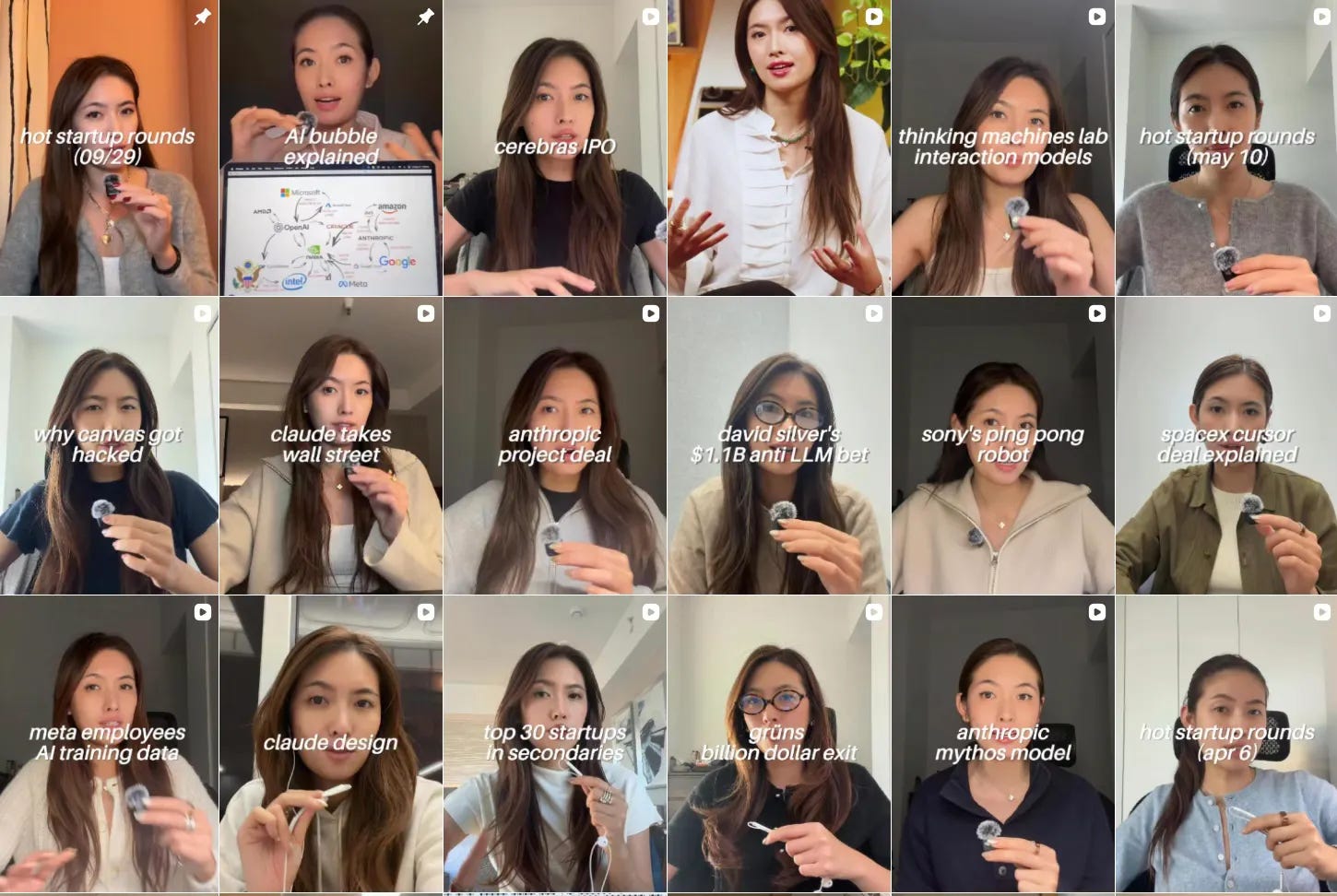
First, Lightspeed hired a creator named Claire Zau as “Investor & New Media.” She’d spent six years investing and the last year building a media platform, her new mandate is to invest in early-stage companies, run the firm’s social channels and co-host a new show.
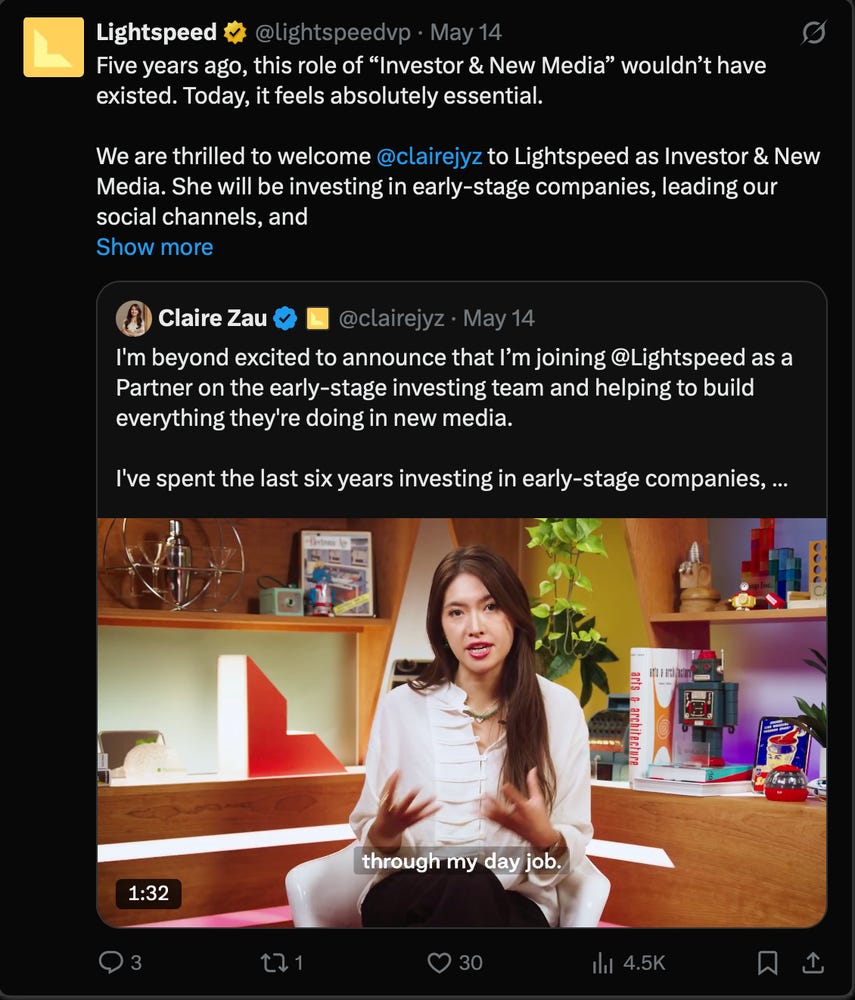
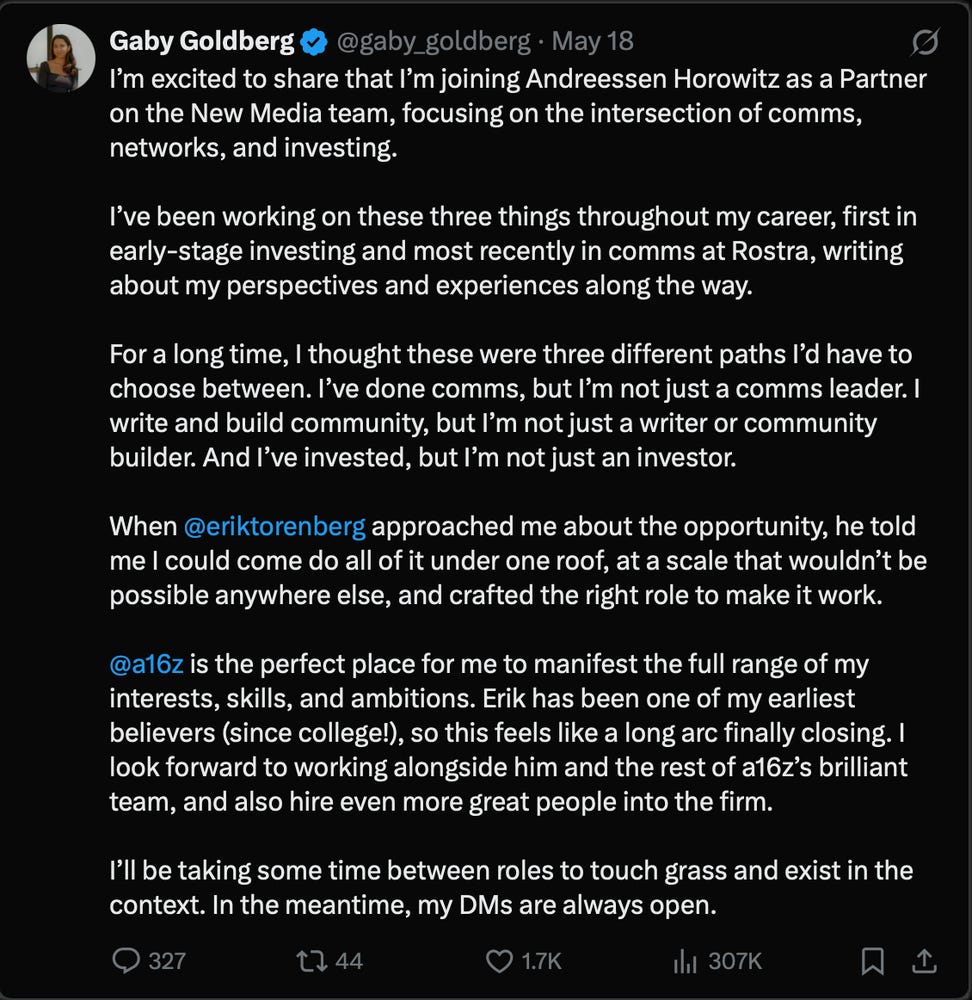
The firm said the quiet part out loud, this role wouldn’t have existed five years ago, and now it feels essential. Days later, a16z announced the same move. Gaby Goldberg joined as a Partner on its New Media team in her words, working at “the intersection of comms, networks, and investing.”
Two firms. One week. A brand-new kind of partner. When two institutions this powerful invent the same role at the same moment, it isn’t a hiring quirk, it’s a sign that a trend already reorganized the thing they compete on. They didn’t hire investors who happen to have audiences.
They hired people who can shape how technology stories spread, at the exact moment that shaping stories became more valuable to a fund than the money in its account.This essay is about why that happened and why it’s structural rather than fashionable.
The short version: capital stopped being the product. And once you see that, the strange new behavior of venture firms the podcasts, the fellowships, the creators-turned-partners, the funds that look more like media companies every quarter, stops looking strange and starts looking inevitable.
The commodity problem
Start with the thing nobody in venture likes to say out loud: there is too much money. By the end of 2023, the United States had more than 3,400 venture firms managing over a trillion dollars, sitting on a record pile of dry powder. The number of funds had multiplied for fifteen years.
When the supply of anything explodes like that, the marginal unit stops mattering. A founder raising a round in 2026 is not short on offers. The dollar from one fund spends exactly like the dollar from another. So for the last decade, firms competed on everything except the dollar.
They called it “value-add”: recruiting help, introductions, operational guidance, platform teams. For a while it worked. Then everyone copied it, and value-add became table stakes, the venture equivalent of a hotel advertising that the rooms have beds. Here’s the part that sharpens the whole picture, and it’s the opposite of what abundance would suggest. The money is not just abundant; it’s concentrating violently. In 2024, two funds raised nearly half of all venture capital in the United States. First-time fund formation collapsed by roughly 86% over four years. Almost all the capital now flows to a handful of established mega-firms.
Put those two facts together and you get the real condition of the market. If you are a mega-fund, capital is your moat. If you are anyone else an emerging manager, a new partner, a solo GP, a fund outside the top thirty you cannot win on capital, because you will never have enough of it relative to the giants, and the giants are taking the lion’s share.
So what’s left? For everyone who isn’t already a mega-fund, exactly one lever remains: distribution. Not as a nice-to-have. As the only available moat.This is the pressure that bends the entire industry toward media. It isn’t aesthetic. It’s the math of a barbell market squeezing everyone in the middle toward the one differentiator a small player can still build.
The flippening
The second thing that changed is where reputation gets made.
Fifteen years ago, a founder built credibility through a predictable funnel: get covered by TechCrunch, profiled in Forbes, quoted in the Journal. Legacy outlets conferred validation — “as seen in WSJ” — and the water cooler conversation in tech was a reaction to what those outlets published. Journalists were the moderators of the narrative, and having their ear was the job of every VC’s PR team.
That funnel inverted. Today the conversation that shapes opinion happens first on X, gets analyzed on Substack, gets synthesized on shows like TBPN, and then sometimes the Journal files a story about it. Legacy media is now downstream of practitioner channels. When a scandal breaks, the most powerful people in tech aren’t refreshing the Times; they’re waiting for the person to explain themselves on a podcast.
Validation didn’t disappear. It migrated. The new gatekeeper is a guest slot, not a byline:

The hyperbole is the point. A daily tech show that started as two friends riffing on the news became, within a year, a credentialing mechanism being on it signals you’re “in the mix,” the way a TechCrunch feature once did. Reputation is no longer something a journalist grants you. It’s something you accumulate, in public, by being consistently worth listening to.
And this matters for venture because of one consequence: founders now form their opinions about firms in public, before the first meeting. A founder doesn’t decide between two funds based on a pitch deck. They decide based on what they already absorbed like whose essays they read, whose podcast they listen to on the drive and whose takes they nodded along to for two years. By the time they take the meeting, the decision is half-made, and it was made in the feed.
Which means whoever owns the conversation owns the top of the funnel for the best founders. That is not a PR function. That is a media function. And it is the single most leveraged thing a fund can build, because it compounds while you sleep and it can’t be bought with a bigger check.
The inversion

Here is the thesis, stated plainly.
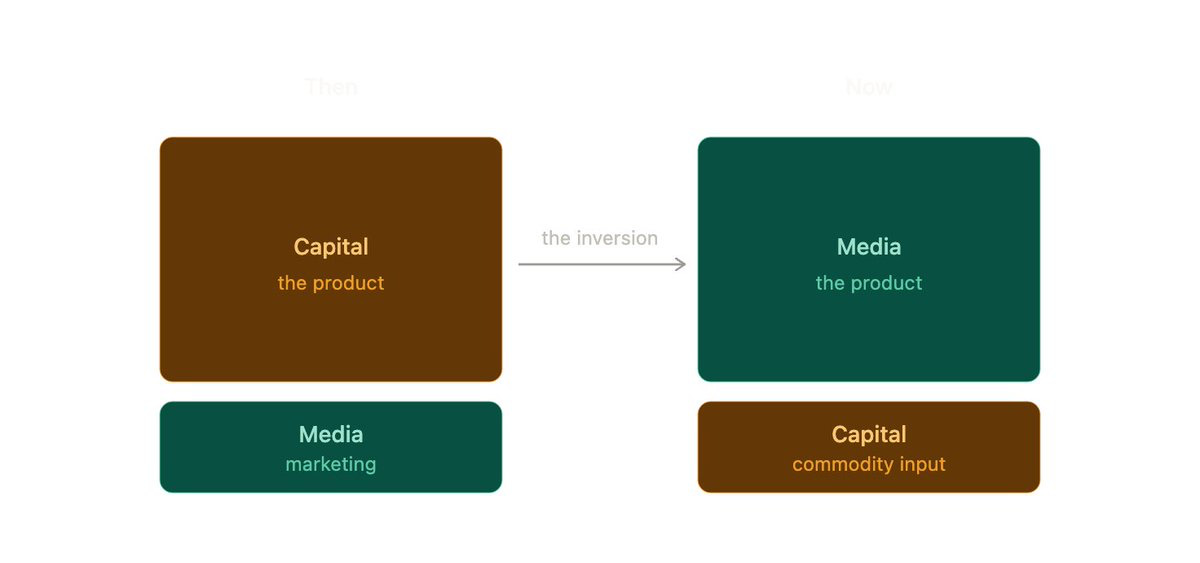
For most of venture’s history, capital was the product and media was the marketing. A firm raised a fund, deployed it and used communications like press, conferences, the occasional blog to make itself look smart so it could raise the next one. Media served capital.
That relationship has flipped. Media is now the product, and capital is the commodity input.
Read that again, because it’s the whole argument. The thing that actually attracts the best founders is the firm’s narrative, audience and distribution. The capital is the easy part its abundant, fungible and available from three thousand other firms. The scarce, differentiating, defensible asset is the media operation. So the fund increasingly is a media company and the checkbook is the subsidiary.
This isn’t a fringe observation anymore; it’s becoming the consensus among the people watching closely. As Jade Conner put it in a widely-shared 2026 essay, Distribution Wins Deals:
“The best venture capital firms are no longer just capital allocators. They are media companies.”
You can see the inversion most clearly at a16z, which has been running this play longer than anyone and stopped hiding it. The firm had more marketers than investors before it had a track record, a deliberate choice in 2009, when the bet was that a venture firm should provide narrative the way it provides recruiting.
The 2023–2025 escalation made the inversion explicit: a dedicated New Media team operating like a production studio crossed with a newsroom, a daily podcast and daily newsletter built to be habit-forming, an annual “Big Ideas” report staged as a coordinated media event, and partner-level voices kept in steady public circulation. Hiring Gaby Goldberg onto that New Media team “comms, networks, and investing” in one role is the same strategy reaching the partner line.
The point of all of it is stated in the firm’s own framing: win the timeline so that the best founders preferentially attach to the firm before they ever raise. That is not marketing a capital product. That is a media product whose downstream monetization happens to be venture returns. The roles inverted, and a16z simply admitted it first.
Why creators, specifically
If media is the product, the people who can build it become the most valuable hires. And the people who can build it are creators.
Not influencers, creators in the specific sense the best funds mean it: practitioners who have spent years accumulating a concentrated audience of exactly the founders and operators a fund wants to reach. The asset isn’t follower count. It’s positional ownership of a conversation. This is why a fund will hire someone with two hundred thousand relevant followers over a celebrity with ten million irrelevant ones. Relevance density beats reach. A creator who owns the AI-infrastructure conversation is worth more to a deep-tech fund than a movie star, because the deep-tech founders are in the first audience and absent from the second.
Then there’s the part that breaks the old rules of media entirely. In journalism, an investor talking up a sector they’re invested in is a conflict of interest, something to disclose, something that erodes trust. In creator-led media, the same fact is read as a signal of conviction. When a VC on a podcast talks up a space, the audience assumes they’re putting money there, and that makes the view more credible, not less. Skin in the game flips from disqualifying to qualifying.
This is the quiet reason creator operators are dethroning traditional marketers inside funds. A marketer runs campaigns from the outside; they observe the industry and package it. A creator-operator articulates the industry from the inside, with their own capital and reputation on the line. Founders can feel the difference, and they prefer the practitioner who has built something to the communications professional who has marketed something. The marketer optimizes for impressions. The creator-operator optimizes for trust and trust is the currency that actually moves deals.
The two paths converge
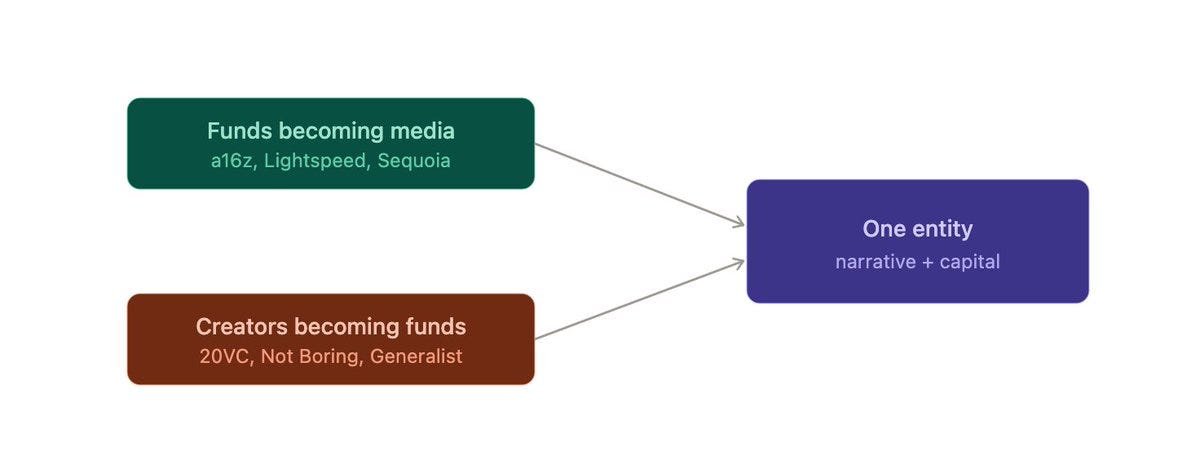
Watch this from both ends and you see the same point in the middle.
From one end, funds are becoming media companies. First Round did it earliest, operating a publishing house inside a venture firm a long-form knowledge platform and a founder-survey report that founders returned to for years, until the content engine became part of how they evaluated the firm. a16z industrialized it. Sequoia and Lightspeed built content arms.
The direction is unmistakable: capital firms are vertically integrating into media because sponsoring someone else’s audience is no longer enough the real advantage comes from owning the show.
From the other end, creators are becoming funds. Harry Stebbings recorded a podcast in his bedroom with a forty-dollar microphone, turned the audience into a living rolodex of venture, and built a firm now managing over six hundred million dollars the podcast still sitting at the top of the funnel. Mario Gabriele turned a research newsletter into a fund, then into a partnership at an established firm. Packy McCormick turned a newsletter into Not Boring Capital. Paige Doherty turned a Gen-Z storytelling brand into a fund. The pattern repeats: build the audience first, formalize the capital second. Reverse the order of legitimacy.
These two paths are converging on the same creature: an entity that owns both the narrative and the capital, where the narrative does the acquiring and the capital does the monetizing. The Lightspeed and a16z hires are just the convergence happening inside a single org chart a fund reaching out to pull a creator across the line, because building that audience from scratch would take five years and hiring it takes thirty days.
And the clearest institutional expression of all of this is a16z’s New Media Fellowship: an eight-week program that drew over two thousand applications and selected roughly sixty-five fellows not founders, not engineers, but storytellers trained in narrative and distribution and then embedded inside portfolio companies. Which points at something bigger than media.
The fund as a talent network
The Fellowship reveals the move most people miss. a16z isn’t just building a media company. It’s building a pipeline of narrative talent it can deploy across an entire portfolio. They call it forward-deployed media — train the operators, then place them inside the startups.
This changes what a venture firm fundamentally is. It is no longer a pool of capital with a media department attached. It is becoming a distribution infrastructure provider to its companies, where capital is one of several things it supplies, alongside trained storytellers, an owned audience, and a launch machine that can put a founder’s message in front of the right people in a coordinated blitz. The fund’s product is no longer “money plus advice.” It’s “money plus the ability to win attention,” and the second half is the part that’s actually scarce.
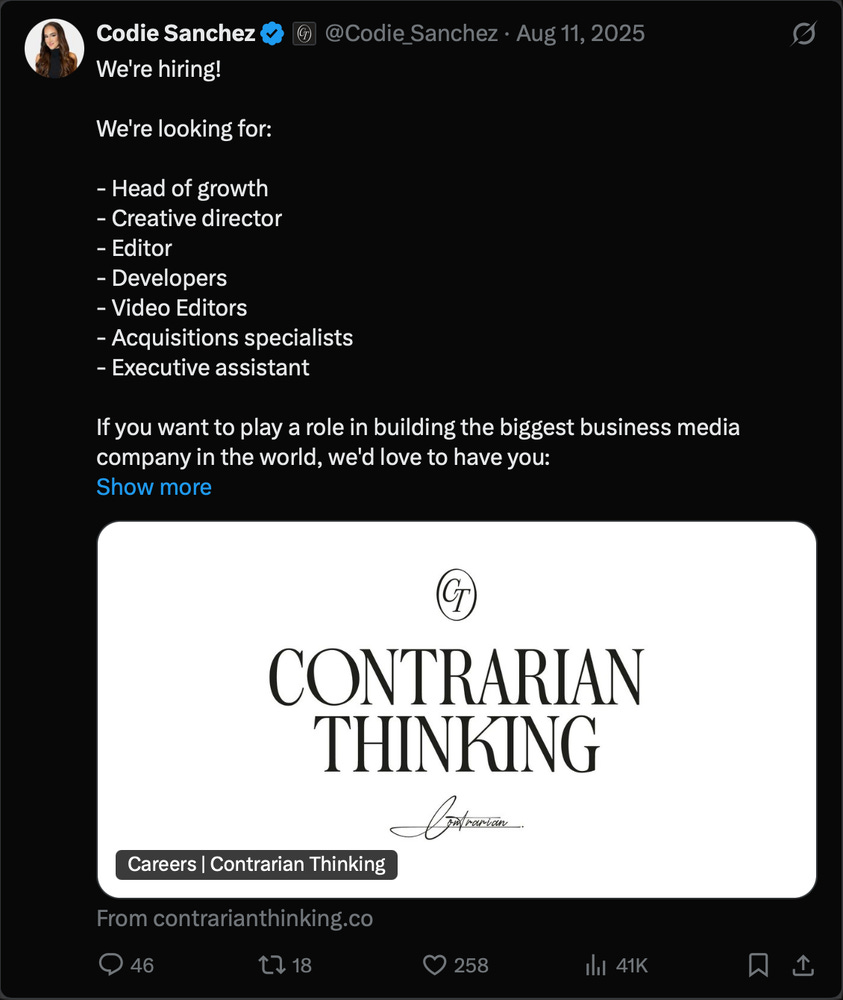
Which is why the next generation of venture talent looks nothing like the last. The previous generation came from banking and consulting — people fluent in spreadsheets and diligence. The emerging generation is fluent in narrative: people who can write, film, build an audience, and shape a conversation. The “Investor & New Media” and “New Media partner” titles are the leading edge of a broader re-staffing.
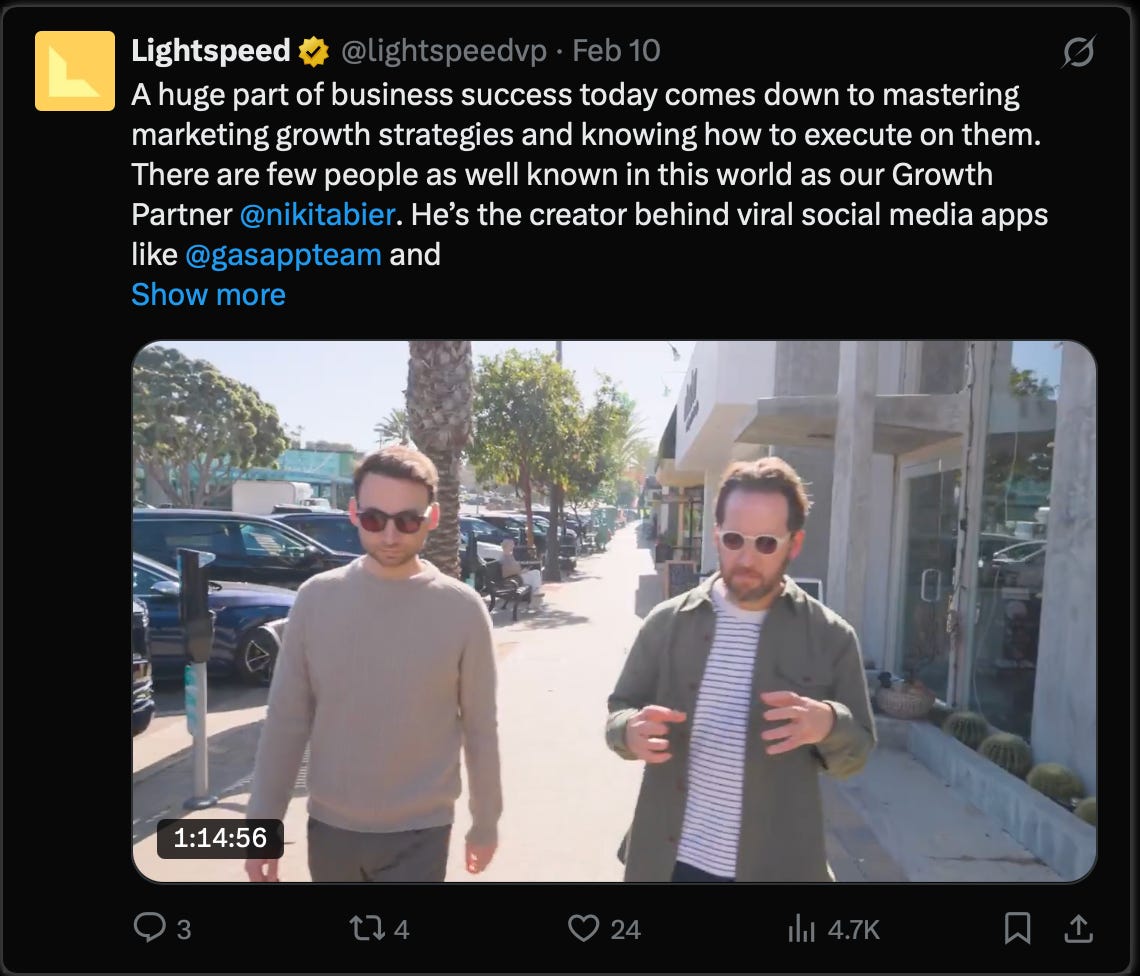
When the firm’s competitive weapon is distribution, the most valuable hire is the person who can build it — and that person is far more likely to have run a podcast than a leveraged buyout.The creator-to-operator-to-allocator pipeline is becoming a real career path. It used to run one way: succeed as an operator, then maybe become an investor. Now it runs through media. Build an audience, get pulled into a fund as a partner or embedded as an operator, and the audience itself is the credential. The thing that used to be a side project posting online became the on-ramp to capital.
Where it breaks
A thesis is only worth reading if it tells you where it fails. This one has four real fractures.
It depends on people, and people are fragile. Almost every property in this story is one or two charismatic humans. Audiences attach to faces, not mastheads. A newspaper can swap reporters and survive; a creator-led fund inherits the burnout, the scandals and the reputational swings of its principals. Funds are supposed to be durable institutions. They are increasingly built on the most volatile asset there is a person’s standing online.
Owned distribution is a slogan, not a reality. Everyone preaches “own your audience” while depending entirely on X, YouTube, and Substack for the discovery that fills it. An algorithm change can reset a growth trajectory overnight. The email list helps, but acquisition still runs through platforms nobody in this story controls. The moat sits on rented land.
Trust may be self-arbitraging. The whole model rests on the skin-in-the-game inversion: audiences trust investor-creators because they’re invested. But if every fund becomes a cheerleader for its own portfolio, the rational audience eventually discounts all of it. The trust that makes creator-led venture media work could be the exact thing it consumes. And there’s a related cost the industry is quietly paying: creator-led media excels at synthesis and founder storytelling but structurally underproduces investigative depth. The system is being tuned to amplify upside and starve hard questions — until a large enough scandal forces a correction. Media might commoditize like “value-add” did. This is the sharpest objection. If every fund becomes a media company, then media stops being a differentiator the same fate that befell platform teams. The honest answer is that the tactic commoditizes but the position does not. Anyone can start a podcast. Almost no one can own a conversation. The funds that win won’t be the ones that produce the most content; they’ll be the ones whose taste and access can’t be replicated by a competitor with a microphone and a budget. Distribution is commoditizing. Positional ownership is not.
The fund of the next decade
The firms that win the next decade of venture will not be the ones with the most capital. Capital is the commodity now abundant for the giants, irrelevant as a differentiator for everyone else.
They will be the ones who understood, earlier than their peers, that they were no longer in the money business. They were in the attention business, with a capital subsidiary attached.
A venture firm used to be a balance sheet that told a story to raise its next fund. The firm of the next decade is a media company that allocates capital one that owns a conversation, trains the people who shape it, and treats distribution as the asset and the check as the cost of entry.
The creators saw it first. That’s why the funds are hiring them. And it’s why, within a single week in May 2026, two of the most powerful firms in venture Lightspeed and a16z crypto both decided they needed a partner for new media, while firms like Sequoia Capital, Index Ventures , General Catalyst and others continue to scale their own content studios, creator fellowships and distribution moats and why, five years from now, that won’t sound novel at all. It’ll just sound like what a partner is.
Really great article, loved reading your breakdown. Thanks for sharing my article as well!
Impressive